
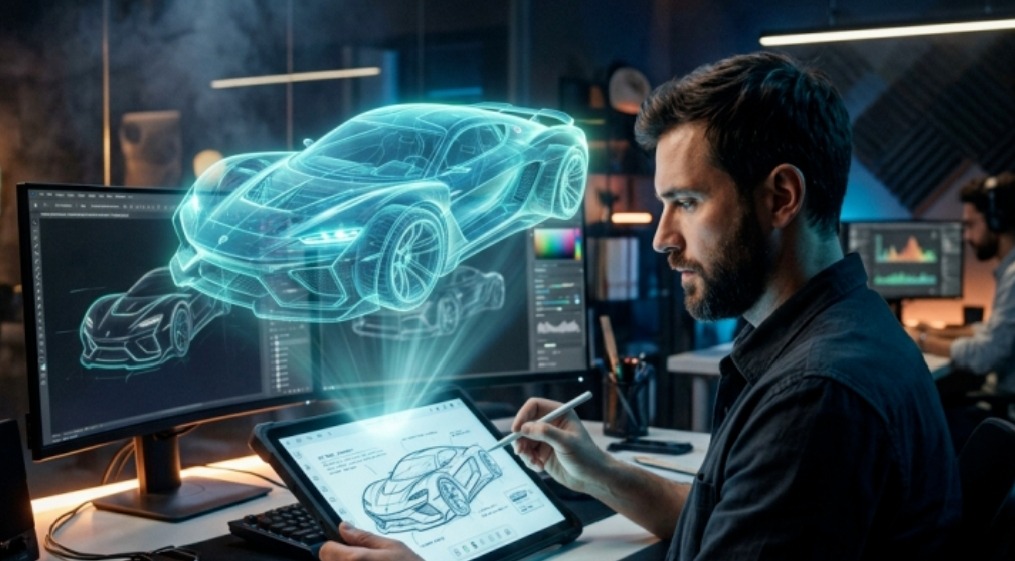
The digital marketing and design sectors thrive on the rapid visualization of new concepts. Historically, transitioning an abstract idea into a fully realized visual campaign required a fragmented workflow, moving from textual briefs to 2D concept art, and finally to expensive 3D modeling. This linear pipeline is fundamentally changing due to the introduction of generative artificial intelligence. By integrating deep learning models into the creative process, agencies can now instantly generate complex visuals directly from text. Leading this structural shift in creative technology is Neural4D, an advanced spatial generation framework jointly developed by Nanjing University, DreamTech, Oxford University, and Fudan University. This academic and commercial alliance has produced a unified system that bridges the gap between two-dimensional imagery and three-dimensional space.
When creative directors and digital marketers need to prototype a new product or establish a visual campaign, they are increasingly relying on the top AI 3D Image Generator to bypass traditional drafting phases. Instead of waiting weeks for a concept artist and a technical modeler to iterate on a design, a marketing team can generate a highly detailed 2D illustration in seconds. More critically, the underlying neural architecture allows that generated illustration to be instantly reconstructed into a fully volumetric 3D model, establishing a seamless, closed-loop creative pipeline.
The Closed-Loop Creative Pipeline
The true power of modern generative platforms is not simply in creating a flat image, but in how that image serves as a mathematical blueprint for spatial reconstruction. This synergistic closed-loop pipeline completely redefines digital asset creation.
When a 2D image is generated, the AI utilizes inverse rendering to analyze the composition. It calculates the theoretical light sources, the casting of shadows, and the physical perspective of the objects within the frame.
> By performing complex volumetric estimation, the system deduces what the unseen angles of the generated image should look like. It mathematically extrapolates a complete, quad-dominant 3D mesh directly from the pixels of the 2D illustration.
This means a designer can conceptualize a futuristic vehicle or a new retail product in 2D, and within minutes, export a fully textured 3D asset ready for augmented reality deployment or video game integration.
Solving the Material Extraction Challenge
Generating a 3D shape is only half of the digital design process. For an asset to be usable in a professional marketing campaign, its surface textures must react realistically to virtual lighting.
Advanced AI systems automate this process through intrinsic material decomposition. The algorithm separates the object’s core geometry from the lighting conditions baked into the original 2D generated image. It then applies precise Physically Based Rendering (PBR) layers to the new 3D model.
1. Albedo Mapping: The system extracts the pure base colors, completely devoid of highlights or shadows.
2. Roughness Mapping: The AI determines the optical properties of the surface, ensuring that a metallic bumper looks highly reflective while a rubber tire appears appropriately matte.
3. Normal Mapping: High-frequency details, such as the texture of concrete or the weave of fabric, are generated to simulate physical depth without adding heavy polygonal geometry.
This automated material extraction ensures that the 3D models generated from AI illustrations maintain a photorealistic aesthetic, suitable for high-end digital advertising.
Utilizing Open Ecosystems for Physical Production
While these digital models are primarily used for virtual campaigns, many marketing initiatives eventually require physical prototypes or promotional merchandise. A 3D model generated by AI can be exported directly for additive manufacturing, allowing brands to 3D print their digital concepts.
However, printing a complex promotional item often requires supportive structural elements. Rather than spending valuable design hours modeling basic display stands or structural supports, creative teams operate within collaborative networks. Designers will frequently consult a DIY3D printable model catalog to source highly optimized, community-tested structural files. By combining their proprietary, AI-generated hero asset with open-source structural bases, marketing teams can accelerate the physical prototyping phase of their campaigns, maximizing both creative bandwidth and production speed.
A Unified Approach to Digital Creation
The convergence of text-to-image generation and automated 3D reconstruction is dismantling the historical barriers of digital design. By eliminating the technical friction between 2D conceptualization and spatial modeling, generative AI empowers marketers and creators to iterate on visual campaigns with unprecedented agility. The capacity to instantly translate a flat illustration into a fully textured, interactive 3D asset ensures that creative teams can deploy immersive content rapidly. As these neural frameworks continue to refine their spatial reasoning, the workflow of digital marketing will become entirely holistic, allowing a single textual concept to automatically populate both two-dimensional media and complex spatial environments.

